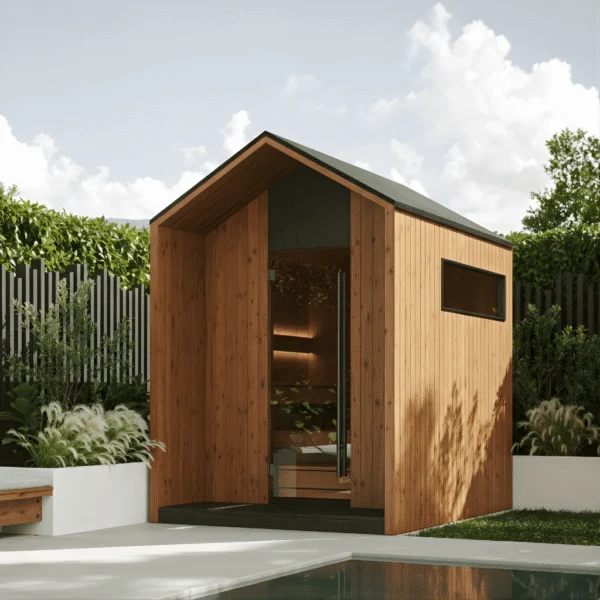

 Saunas
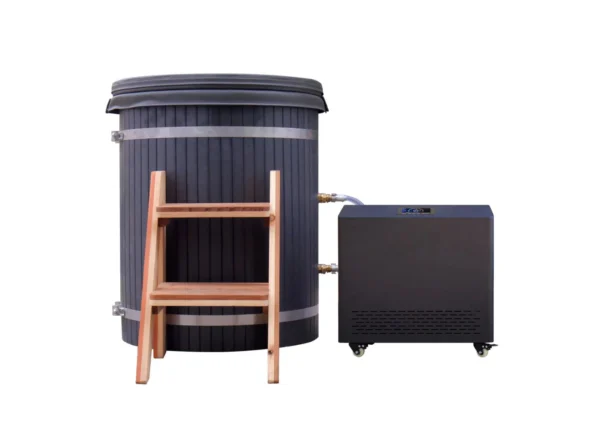
 Ice baths
 Golf simulators
Installation and guides
Plain-English guidance for the three rooms we sell. Always follow the manufacturer’s manual for your model; where it differs from this guide, the manual wins.
Saunas · Infrared saunas · Ice baths · Golf simulators · Electrics at a glance
Traditional saunas: indoor and garden
Choosing the place
- Indoors: a spare room, home gym, garage or large bathroom. Leave a small gap at the back and sides for ventilation, and check the largest panel fits through every door and stairway on the way in (each product page lists the panel size where the maker gives it).
- Garden: pick level ground with room to walk round the sauna for building and upkeep, ideally away from overhanging trees.
The base
Garden saunas need a firm, level, free-draining base slightly larger than the footprint: a concrete slab, laid paving slabs or a well-built timber deck. Barrel saunas sit on their supplied cradles, so the base only has to be level and solid under them. A level base matters: doors and staves only line up when the floor beneath them is true.
Planning permission
Most garden saunas count as outbuildings under permitted development, provided they meet the size and height limits. For example, a building within 2 m of a boundary can be no more than 2.5 m tall, and outbuildings can’t cover more than half the garden. Check with your local council or the Planning Portal if your home is listed, in a conservation area or national park, or the sauna is larger.
Electrics for electric heaters
Electric sauna heaters are hard-wired on their own dedicated circuit, protected by an RCD, by a qualified electrician working to BS 7671 (the IET Wiring Regulations). In England and Wales a new circuit is notifiable under Part P of the Building Regulations, so use a registered electrician who can self-certify the work. Garden saunas usually need an armoured cable run from the house. See Electrics at a glance for typical currents.
Wood-burning heaters
Wood-burning heaters need no electricity, but they need their full flue kit, heat shields and the clearances in the manual. If you live in a smoke control area, which covers much of London and many other towns, check with your council before buying: you may only be allowed to burn authorised fuel in an exempt appliance.
Ventilation and first use
Fit the air vents supplied, in the positions shown in the manual. Before your first session, run the empty sauna at full heat for about an hour with the vents open, so the heater and stones burn off any manufacturing residue. Then rinse the stones if the manual asks you to.
Looking after it
- Wipe the benches after use and leave the door ajar so the timber dries.
- Treat outdoor timber with the oil or stain the maker recommends, usually once or twice a year.
- Re-stack or replace cracked sauna stones once a year; heavy use may need it more often.
Safe sessions
Start with 8 to 12 minutes, drink water, and leave if you feel dizzy or unwell. Avoid alcohol before and during a session, and supervise children. If you’re pregnant or have a heart or blood-pressure condition, talk to your GP first.
Infrared saunas
- Most infrared cabins we sell run from a standard 13 A socket. Plug straight into the wall: no extension leads or adaptors.
- They’re for indoor use only, on a level, dry floor.
- Infrared cabins run cooler than traditional saunas (around 18 to 65°C), because the carbon panels warm your body directly. Sessions of 15 to 30 minutes are typical.
- Assembly is usually a two-person job: panels clip or screw together and the wiring connects with plugs between panels.
Ice baths
Placement and power
- Stand the tub on a level surface that can take the weight of the filled bath (a 200 to 400 litre tub weighs 250 to 500 kg filled).
- The chiller plugs into a standard UK socket. Outdoors, use a weatherproof socket protected by an RCD, and keep the chiller where the manual says, with space around it for airflow.
Filling and water care
- Fill with clean tap water, then set the target temperature on the panel or app. Cooling from tap temperature to 3°C takes a few hours.
- The built-in filter and ozone treatment keep the water clean between changes. Rinse the filter regularly, keep the lid on, and change the water as often as the manual recommends.
Safe sessions
Cold water immersion isn’t right for everyone. Start warmer (10 to 15°C) for one to two minutes, never go in alone or after alcohol, and get out if you feel numb, dizzy or short of breath. Talk to your GP first if you have a heart condition, high blood pressure, Raynaud’s or are pregnant.
Golf simulators
Room size
| Measurement | Comfortable | Minimum |
|---|---|---|
| Ceiling height | 2.7 m or more for most golfers to swing a driver | About 2.5 to 2.6 m for shorter golfers or irons only |
| Width | 3 m or more, to stand centrally and suit left and right-handers | About 2.6 m with a compact enclosure, set to one side |
| Length | 4.5 to 5 m or more from the screen to behind your backswing | About 4 m with a camera launch monitor |
Try the room checker on our home page: enter your measurements and it lists the enclosures that fit. For enclosures, allow about 15 cm either side of the frame and about 30 cm behind the screen so the screen can absorb impacts without touching the wall.
Launch monitors
- Camera (photometric) units such as Uneekor, Square Golf, Bushnell, SkyTrak, TruGolf and NVISAGE sit beside the ball, so they suit shorter rooms.
- Radar units such as the Golfzon WAVE radar sit behind you and need enough distance to track the ball, so they prefer longer rooms.
- Check what software each unit uses and whether courses need a subscription; each product page explains this.
Projector and computer
- Most home bays use a short-throw projector mounted on the ceiling or in a floor box, so you don’t cast a shadow on the screen. Match the projector’s aspect ratio to the screen.
- Simulator software such as GSPro or E6 Connect runs on a Windows PC; check the software maker’s current graphics card requirements before you buy a PC.
- Use a proper hitting mat: it protects your joints and the floor, and gives the launch monitor a consistent surface.
Electrics at a glance
Typical current drawn by an electric sauna heater on a 230 V single-phase supply (power divided by voltage). Your electrician chooses the cable, breaker and protection for your installation, and may recommend a three-phase supply for the largest heaters.
| Heater | Typical current at 230 V |
|---|---|
| 3.5 kW | about 15 A |
| 4.5 kW | about 20 A |
| 6 kW | about 26 A |
| 8 kW | about 35 A |
| 9 kW | about 39 A |
| 10.5 kW | about 46 A |
| 15 kW | about 65 A (often three-phase) |
Infrared saunas, ice bath chillers and launch monitors usually plug into a standard 13 A socket.
Still planning?
Email contact@clubhaushome.co.uk with your room sizes or a photo of the space and the model you’re considering. We reply within one business day.
